
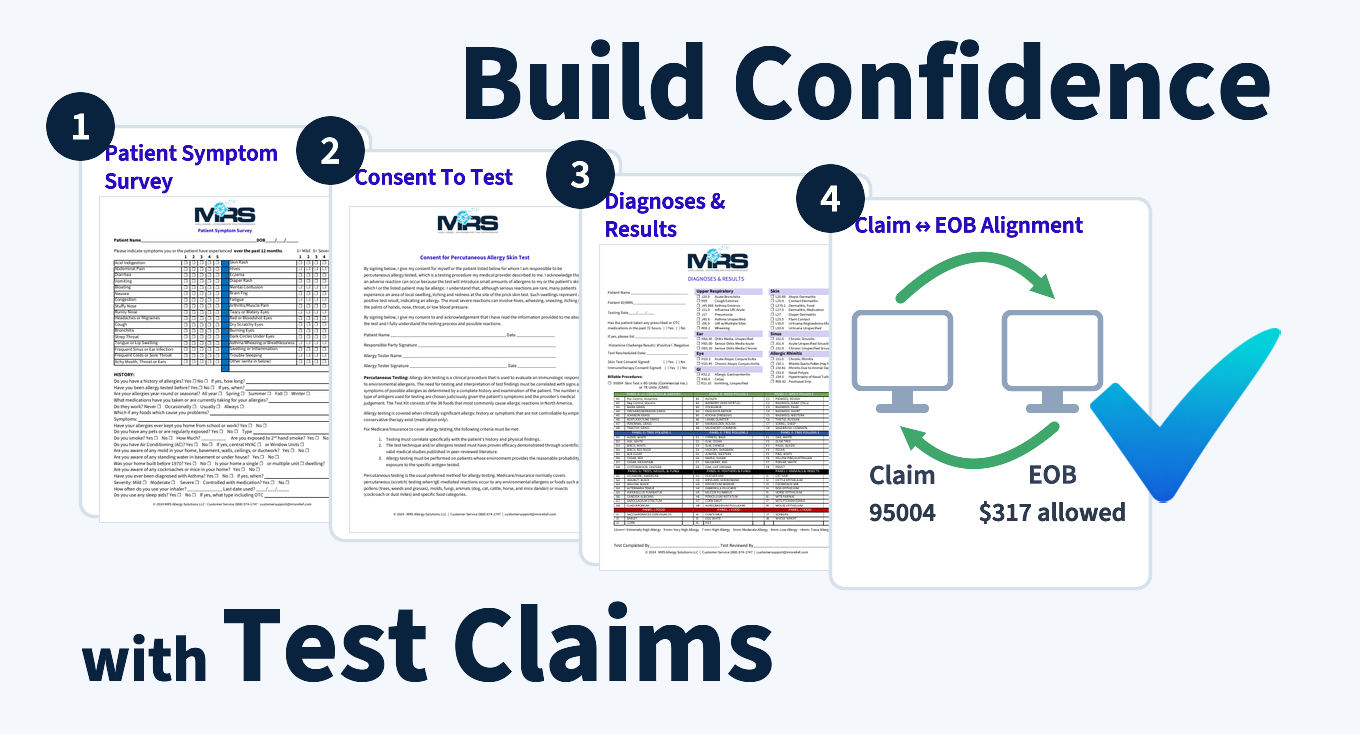
Maximizing Confidence in the Purchase Decision: Test Claims
Reviewing the medical statistics, reimbursements, and operational realities will readily lead practice owners to conclude that allergy belongs in primary care. Further research will reveal multiple business models for implementing an allergy program. At the end of the day, allergy testing is a service line best implemented in-house using existing staff, trained and equipped with the assistance of a true turnkey allergy program from a provider of both materials and training/support services. The financial case is persuasive too, as detailed in our discussion of allergy testing reimbursement, CPT codes, and revenue economics. Just the simple fact that reimbursements outpace material costs by an eye-popping margin is readily apparent from real-life EOB examples we shared.
Yet, particularly cautious clinics may prefer to invest a little more time and effort internally to bolster confidence before investing cash in an allergy program. The financial aspect is only one of several important considerations in making that decision, others including operational fit, training support, and business model. The money part is a big one, though, and the reality check is easy. First, have the billing team file and work a few test claims, sometimes called dummy claims because those guys doing the crash testing can’t catch a break. Then, for added assurance, get comfortable with locking down medical-necessity documentation, also easy. For belt and braces, run a simple report from your existing EHR system. With the right parameters, that report will almost certainly confirm that existing patient records reflect allergy-related diagnoses as prevalent as allergy statistics suggest, or at least prevalent enough to justify investing in an allergy program. These low-cost steps mitigate one of the larger sources of early friction: second-guessing whether claims will actually pay, how many will pay, and how much.
Before we dive in, though, a quick note from the office of business-prevention lawyers: This is not billing advice. Of course, every practice should work with its billing team, clearinghouse, and the specific payors on its contracts. What follows is a practical, high-level overview to help clinic decision makers get comfortable with the program purchase authorization using only existing resources.
What Test Claims Will Show
When allergy programs fail, they nearly always fail as a result of operations and administration, not clinically. Clinically, 30-50% of patients having established medical necessity for a test that reimburses at high multiples of material cost is low-risk for failure. But if the reimbursement process fails, such as when claims get denied on documentation technicalities, confidence wanes and the program wilts. Dummy claims build that crucial early experience base, blaze the path, and help make sure no one gets lost.
A dummy, or test, claim is simply a claim submitted with a test patient, real or not-so-real, that lets you see exactly how a given payor responds to CPT codes 95004 and, later, 95165, under your provider numbers and taxonomy for particular plan/payor combinations. The process ought to go smoothly, building confidence.
- For zero-charge or test-patient claims, quite a few commercial payors will return an expected allowed amount, or at least some substantive pricing response, which is often what the cautious clinic is really after.
- You can run your most common payors and claims to get a solid idea of what reimbursements you can actually expect in your clinic, with your patients, in real life.
If additional concerns exist, dummy claims can help the billing team learn to navigate uncommon shoals. Examples include:
- Whether controls are reimbursable in the particular payor/plan combinations you most often bill. Many plans pay them separately as countable units; others, such as Medicare, subsume them within the base payment. Two units atop 78 others is a billing nuance that would only sway the business decision in the most edgy of edge cases.
- Other unit-count limitations, which are rare for a standard 80 panel but occasionally surface in specific situations such as capitated programs.
- Taxonomy differences between family, internal medicine, pediatric, or primary care NPIs versus specialty allergy/immunology NPIs.
- Whether certain ICD-10 combinations trigger a hard rejection or a prior-authorization flag. For instance, J30.1, allergic rhinitis due to pollen; J30.2, other seasonal allergic rhinitis; J30.81, animal dander; J30.89, other allergic rhinitis; and J31.0, chronic rhinitis, may not be treated the same way, especially in doubles or triples. Some combinations may trigger rejection in some payor/plan sets, while the same combination may sail right through the next payor/plan set.
- Prior authorization issues do not arise often for allergy testing, but when they do, it is often where PA is not required on paper benefit descriptions but pops anyway, sometimes in so-called “soft rejections,” in AI-driven contexts, seemingly keying on NPI/payor combinations. Like the taxonomy issue, there have been instances in which AI hard-bounced a 95004 claim because it was a specialty or PA mismatch, then humans intervened to fix it.
- Data mapping failures. Your EHR or other billing software may generate a claim that is clean by any measure and yet still run aground because submitted data fields are not routed to the correct destinations. Usually, running a claim is the only practical way of finding such errors, and it is useful if your clinic has unusual plan/payor combinations.
Most practices that take the time to run dummy claims discover one or two minor mapping issues that take little effort to fix. Virtually all practices that run dummy claims prior to pulling the trigger on adding an allergy program gain the financial confidence they sought.
How Practices Typically Run Dummy Claims
At the risk of preaching to the choir, or stating the painfully obvious, the four-step process for framing and submitting a dummy claim looks like this:
- Create a test patient in the EHR with a realistic demographic and a clear allergy-related diagnosis, or set of diagnoses, already documented in the chart. Many practices simply use a staff member’s own chart under a test flag, or a synthetic patient ID.
- Document medical necessity exactly as you would for a real patient.
- Submit a claim for CPT 95004 with the number of units you intend to bill for a full panel, most commonly 78 or 80. Use a zero charge or a nominal charge so nothing hits a real patient responsibility.
- Watch the remittance or the clearinghouse rejection report. AI will often bounce claims immediately, so the wait is short where that is an issue. Note every code, modifier, or remark that appears.
Often, billing teams can run enough dummy claims in an afternoon to build sufficient confidence to support the financial aspect of a decision to add an allergy program. Usually, the most important result is confidence in the reimbursement amount, or amounts where you’ve run claims in all the most common payor/plan combinations in your patient base. Another result is a short checklist of dos and don’ts for those combinations, which becomes the playbook for the live program.
Stay tuned for Step 2 of 3.