
Real Allergy Testing Reimbursement Examples From EOBs
Allergy Testing Benefits the Practice as Much as the Patients: Real Reimbursement Payments on Actual EOBs
Even for seasoned physicians, or perhaps especially for those whose clinics predate the ACA, health insurance reimbursements can seem like a black box, and that can be as true for allergy testing reimbursement and revenue economics as for any other clinical service. You hire your billing team, you align your process flows to maximize reimbursements while minimizing the labor costs of obtaining them, and you try to practice medicine instead. Perhaps this unpleasant ritual helps explain why providers are reticent to believe the reimbursements for allergy testing in primary care are straightforward and surprisingly high. In the hope of overcoming that justifiable skepticism, let’s look at real reimbursements to real clinics who tested real patients in a true turnkey allergy program. We’re not in the business of collecting EOBs, but in assisting billing departments and smaller clinics from time to time, we do receive a few, and some summaries, too.
THIS IS NOT BILLING ADVICE, but it sure is interesting.
Real Allergy Testing Payments From Actual Clinics
A sizable practice in the Detroit metro with a comparatively low-income patient base, and that offers allergy testing as a service line, gave us this spreadsheet representing actual payments on several weeks of activity in Spring 2024. Most noteworthy is not necessarily the large spread in reimbursements for the exact same MRS Allergy 80 Panel test in the exact same clinic, the black box effect, but the remarkably high maximum payment of $575. The Non-Facility Price for CPT code 95004 in MAC Locality 0820201 in effect at the time was $3.86 per unit. For Medicaid, guidelines suggest controls are no longer billable, so at that unit price an 80 panel works out to $301. The average reimbursement was $317 even in this high Medicaid practice. The material cost of a test is far below $100, so even this clinic is seeing greater than 3x, in fact, nearly 4x ROI, gross direct cost. It’s not apparent from the reimbursement chart, but this clinic also failed to implement the Pt Sx Survey properly. In other words, they were not testing at anywhere near the volume they could and should have been.

Michigan: the same 80-panel test, across the practice’s whole payer mix. Actual payments over several weeks in Spring 2024. Average $317, high $575.44, low $134.20 — the spread on one identical test, in one clinic, is the black-box effect made visible.
All 19 payers and amounts, as text
| Insurance | Average Payment |
|---|---|
| Aetna (AETNA-E) | $313.20 |
| BCBS of Michigan – Ep (BCBSMEP) | $363.58 |
| BCBS of Michigan (BCBSMI) | $399.30 |
| Bcn (BCNE1) | $468.80 |
| Bcn Advantage (BCNADV-E) | $334.77 |
| Blue Cross Complete (Medicaid) (bccom) | $228.69 |
| Cigna Healthcare PPO (CIGNA) | $416.84 |
| Fep BCBS of Michigan (FEPBLUEC) | $575.44 |
| HAP CareSource Medicaid (HCS) | $321.88 |
| Humana Medicare (MEDHUMAN) | $407.48 |
| Mclaren Medicaid Health Plan (Medicaid) | $216.70 |
| Meridian Health Plan Of MI (Medicaid) (MERIDIAN) | $213.55 |
| Meritain Health (MERITAIN) | $333.00 |
| Molina Medicaid (MOLCAID) | $268.61 |
| Priority Health (Priorit2) | $190.40 |
| Priority Health Medicaid (Pri Caid) | $251.61 |
| Priority Health Medicare (PRI-MEDI) | $376.81 |
| United Healthcare Community (UNITED6) | $211.72 |
| Wellcare Dual Access Plan (Wellcare) | $134.20 |

Georgia: $317.52 for the test, $388.38 for the encounter. A Blue Cross Healthy Blue plan allowed $317.52 for a 72-unit allergy test (CPT 95004) and $70.86 for a level III office visit (CPT 99213). Billed $690.00, allowed $388.38.
That $317 payment average i s familiar. Here is one from Georgia reflecting allowed payment for a 72 panel test in the same amount, so the payment rate per unit is actually higher. It also reflects a level III visit code 99213, allowed amount $71, putting the total just shy of $400.
Here’s a Medicare EOB from an Arizona clinic a few years ago. The allowed amount was $462 compared to a CMS Facility Price of $3.48/unit or $251/test even using June 2026 pricing. The material cost of the test is the same anywhere, so GROI is ~5x.
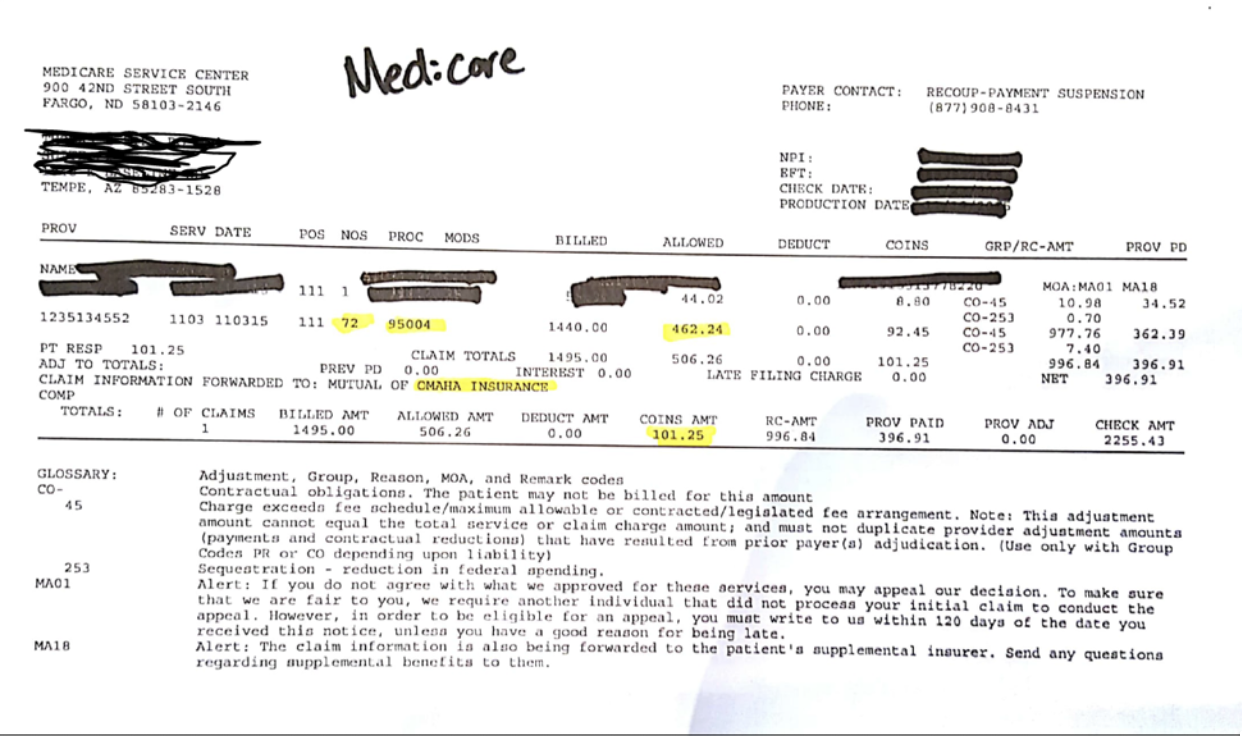
Arizona, billed to Medicare: $462.24. Allowed $462.24 for a 72-unit allergy test (CPT 95004) against $1,440.00 billed. Adjudicated by Noridian, the Medicare contractor in Fargo, North Dakota.
Here’s an Aetna EOB from that same Arizona clinic allowing $400 for a 72 panel, same as the 80 panel but without the foods. That’s well above the CMS price which works out to $279 at $3.98 per unit using June 2026 pricing, not counting controls just to be conservative.
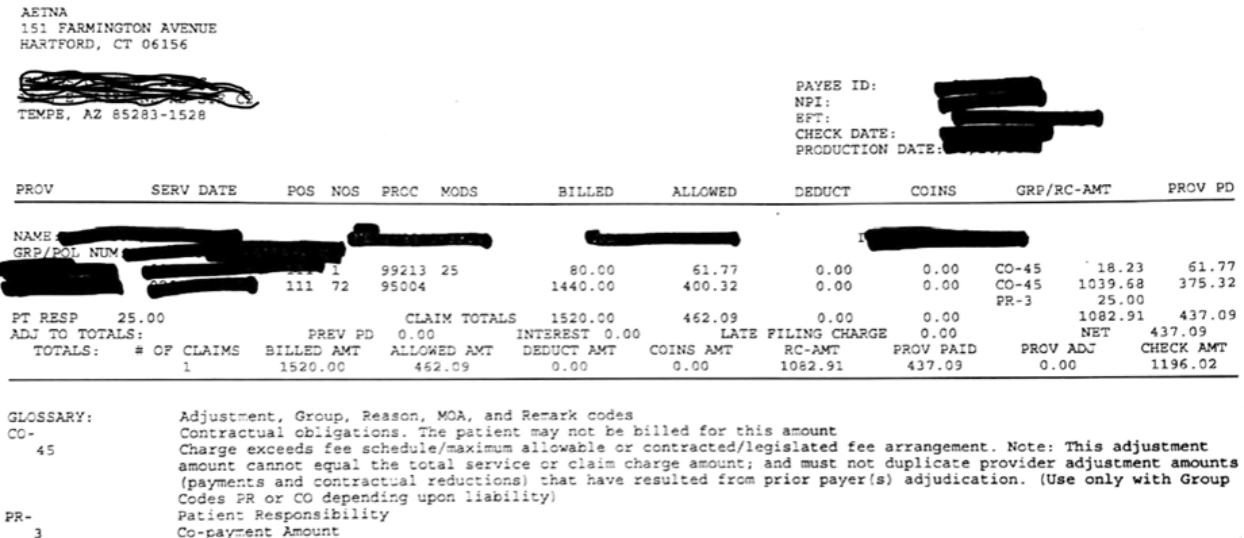
The same Arizona clinic, a commercial payer: $400.32. Aetna allowed $400.32 for a 72-unit allergy test (CPT 95004) plus $61.77 for a level III visit (CPT 99213). Total allowed $462.09.
In New Jersey in 2022 the payor allowed $505 for an 80 panel, plus $145 for a level IV visit, accompanied by a B12 injection that certainly didn’t take 30-39 minutes, so it was either the allergy test or the combination of services that merited Level IV and was paid accordingly.
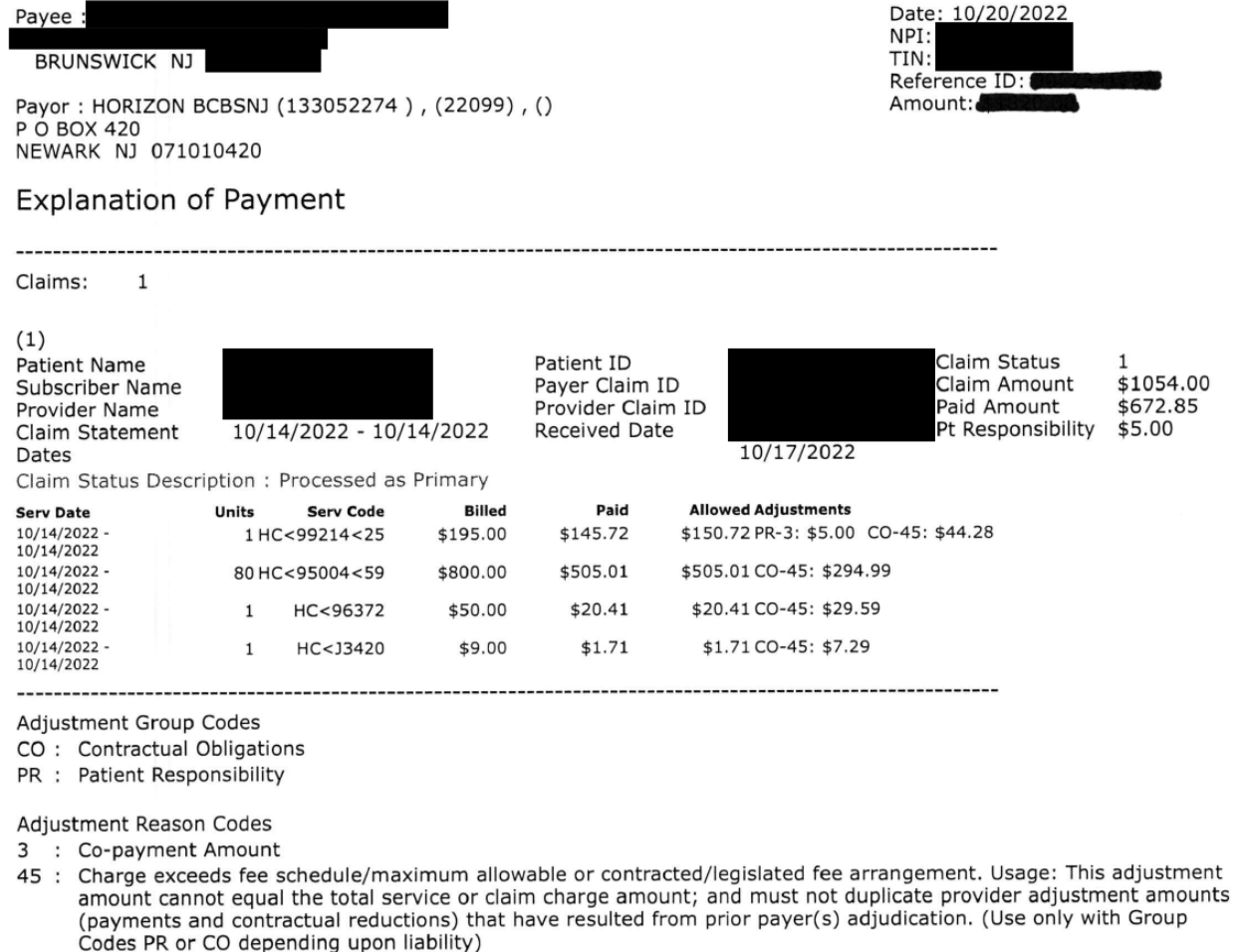
New Jersey: $505.01, plus the visit. Horizon BCBS allowed $505.01 for an 80-unit allergy test (CPT 95004), $145.72 for a level IV visit (CPT 99214), and $22.12 for a B-12 injection (CPT 96372 and J3420). October 2022.
Treatment-Side Reimbursement Examples
This one from Arizona is on the treatment side, CPT 95165 for procurement of allergen serum for SCIT, subcutaneous immunotherapy commonly referred to as allergy shots, with over $1,000 allowed. That would be in addition to codes for injection, 95115 or 95117.
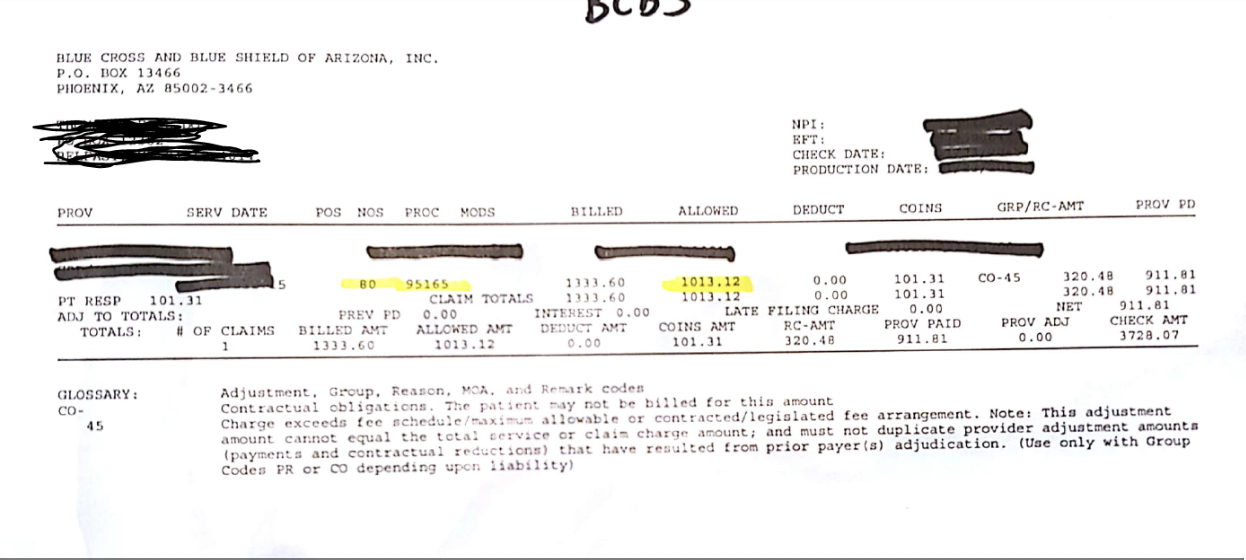
Arizona: $1,013.12 for allergen serum. Blue Cross Blue Shield of Arizona allowed $1,013.12 for 80 units of serum procurement (CPT 95165) — the treatment side, not testing. Injections bill separately under 95115 or 95117.
On the treatment side in Tennessee, this one paid at an even higher rate: for 40 units billed to 95165 the payor allowed $600.
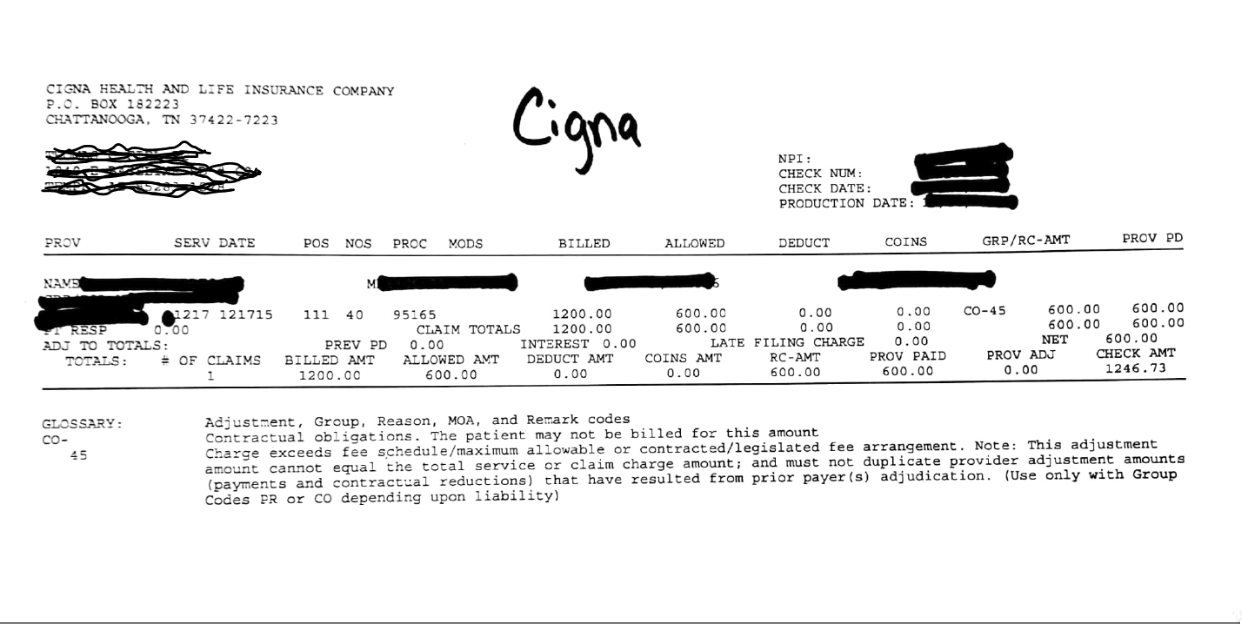
Tennessee: $600 for 40 units. Cigna allowed $600.00 for 40 units of allergen serum (CPT 95165) against $1,200.00 billed — $15.00 per unit, against $12.66 at the Arizona clinic above.
Pressure-Test Reimbursement for Your Own Practice
If you’d really like to pressure test expectations for your own practice, run a few dummy claims. We’d be happy to help. In fact, we can work with your billing partner not only to identify diagnostic codes in your existing patient records that would justify an allergy test, so you can get a firm idea of how many tests are already supported, and then also help submit test claims to assess real world returns for those specific payor/plan combinations in your specific clinic.