Allergy Makes Financial Sense
Adding an allergy program to a primary care practice makes sound financial sense for patients and practitioners alike, to put it mildly. For an overlapping series of four reasons, it’s an excellent investment of a co-pay or deductible payment for the patient:
- Allergy is extremely prevalent (30-50%);
- Most patients who suffer from allergies don’t necessarily know it or request testing;
- Allergy testing in primary care is covered by most plans and payors; and
- Allergy treatment can often make a life changing positive difference.
It makes sense for a practice to add an allergy program for all those reasons, but even more than that, allergy testing as a service line remains among the highest net reimbursements available for diagnostics in the primary care setting. Better still, that net revenue stream can be added quickly and easily with no capital expense or equipment. The utility and financial justification are just as strong for certain specialties, too, such as ophthalmology, otolaryngology, and sleep.
Clinical Utility Is Only Part of the Business Case
In a utopian world, perhaps, the practice of medicine would be free from financial constraints. We don’t live in that world. Instead, generally speaking, good medicine requires sound financial returns, especially over time. Allergy provides them. In fact, the business case for a true turnkey allergy program is as strong as the medical one.
Good Medicine Requires Sustained Business Return
For better or worse, the clinical utility of any diagnostic, treatment, or other medical service is not enough, alone, to warrant inclusion in a medical practice. Every clinic requires funding of one kind or another, public or commercial. Providing services the patient population doesn’t need, or won’t or can’t pay for, that patient insurance won’t cover, and that the clinic can’t get public payment for, is financially unsustainable. That logic extends into allocation of labor as well, maximizing value added labor spent with patients and minimizing labor like billing that only supports funded activity. In the aggregate, a clinic must bring in at least as much funding as it expends.
That’s not to say all services must have net positive reimbursements. On the contrary, excellence in medicine must often account for financial losses on some services, but in the aggregate the net must be positive if it’s to attract and keep the best practitioners.
Further, the selection of offered diagnostics and other services must account for relevance over time. The experience with SARS-CoV-2 in 2020 painfully illustrated this point, in that some clinics invested heavily in expensive equipment for diagnostic analysis that fell out of regular usage within a few years. Planning for CapEx, or capital equipment expenses, in particular, must consider time to first dollar return, and overall return on investment in a given timeframe.
Allergy Provides 2 to 6 Times ROI With Easy Entry and No CapEx
Perhaps uniquely among real world choices, a true turnkey allergy program provides extremely high financial return on a program for which there is not only an enormous unmet need, but that also is remarkably easy to implement and requires no capital expenditure. Clinical staff can be fully trained in under three hours, typically virtually, and every dollar spent on program materials is for direct use on or by a patient. Reimbursement is typically three to six times the material cost of a test with a labor investment of as little as 15 to 20 minutes of an MA’s time. CLIA waived is not technically accurate here; rather, CLIA does not apply at all because allergy skin testing does not entail bodily fluids. All of those positive attributes seem to double in importance when balanced against the alternative: missing those allergic patients entirely, and referring out the comparatively few who are detected. In light of the financial case, in-clinic allergy testing vs lab or specialist referral is no contest at all.
Applicable CPT Codes & Real Payments
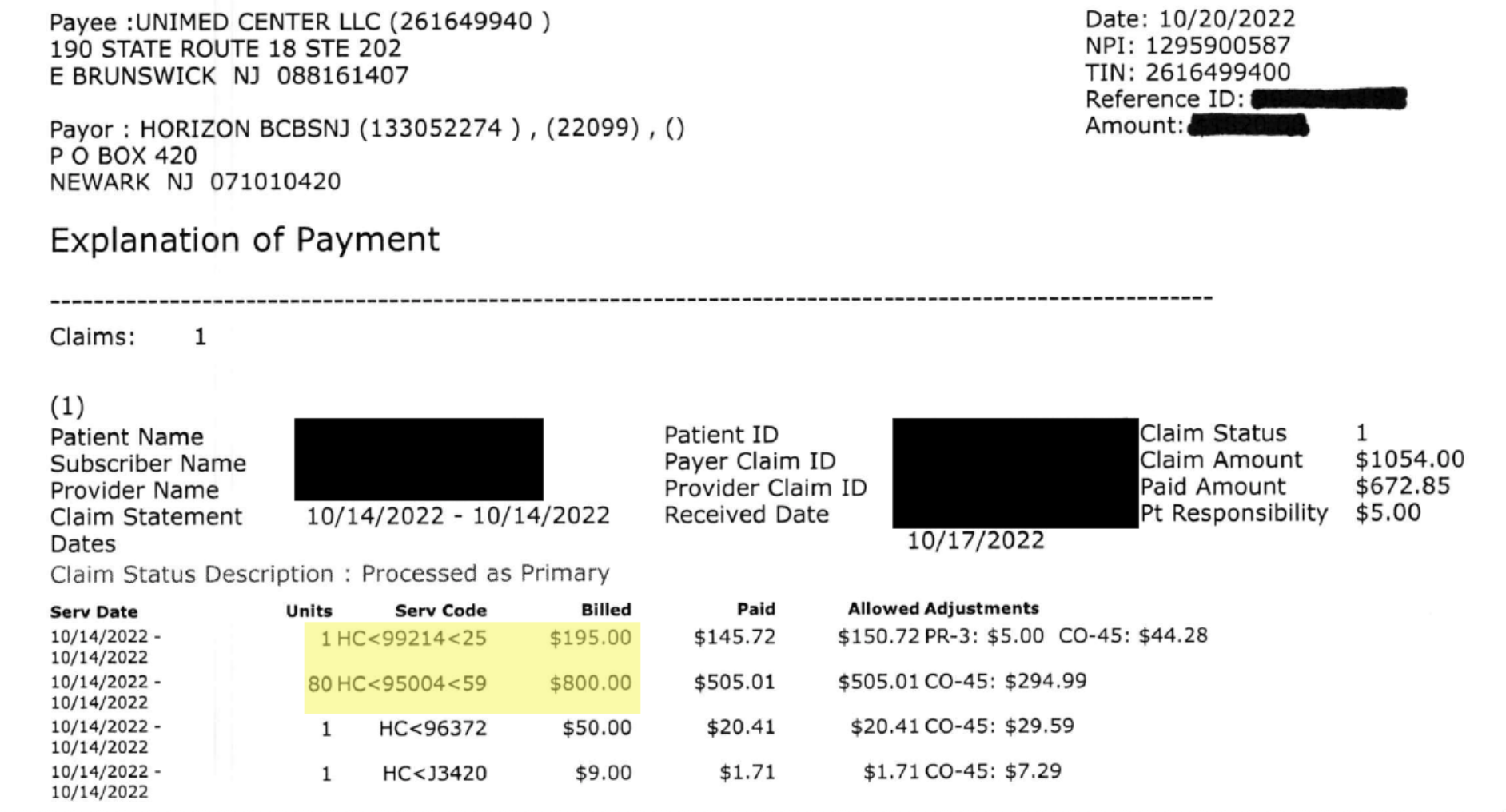
The CPT code for billing an allergy test is 95004. That much is quite straightforward. But there’s more to it. First, most allergy testing is done as a follow-up visit. That is, the need for an allergy test is typically established by a positive result on an allergy symptom survey which is given upon intake and then annually on a screening basis. Typically, the day the patient filled in that survey, he or she came to the clinic for some other reason, such as illness, initial patient establishment, or annual physical. So that visit is also billed.
Additional codes apply for treatment, specifically 95165 for procurement of serum for subcutaneous immunotherapy, and 95115 for a single injection per visit or 95117 for two injections. Some allergens should not be combined with some others, necessitating dual injections for some treatment protocols.
Estimating reimbursement per test starts with unit prices per CMS guidelines, multiplied by number of units, then to the extent applicable adjusted upwards for commercial payors. Specialty immunology/allergy clinics with aggressively negotiated specialist contracts can be paid substantially higher commercial rates than primary care providers. ENT and ophthalmology rates are often in between primary care and immunology rates.
As of July 2026, the per unit reimbursement for allergy skin tests under CMS guidelines runs from $3.09 in Arkansas to $4.88 in Silicon Valley. According to the latest real market paid claim amounts from PayerPrice.com, a primary care provider can expect commercial payors to allow and actually pay between 40% and 80% more than CMS guideline rates, typically. Some paid reimbursements are far higher, 200% and up. For more details and a deeper sense of confidence, we’re pleased to provide real allergy testing reimbursement examples.
National Business Case
Many clinics can get a rough cut of the business case for their specific circumstances by using the “National Payment Amount” CMS price. Using that as a basis, and what according to PayerPrice.com is a conservative 30% increase for commercial reimbursements, plus a few conservative assumptions about treatment — 120 units of serum per patient per year, 8 month build up phase — the expected net revenue per SCIT-treated patient is more than $5,500 using CMS figures, over $8,000 for most commercial patients, and potentially, if rarely, as high as $20,000 for particularly strong commercial contracts. For just the test alone, and limiting reimbursement to the CMS price with no markup, the net revenue is more than 3½ times the cost of materials.
Get a Custom Business Case for Your Own MAC Locality & Clinic
Every clinic is welcome to receive a customized business case just for the asking. Enter the county where your clinic is located, and we’ll translate that to the specific MAC locality and send a table laying out the arithmetic and underlying assumptions in detail. It would be our pleasure to adjust assumptions to match specific circumstances as well, such as annualized expectations based on public/private payor mix of your patient base, multi-location practices, and more.
To test assumptions before you spend a dime, we can work with your billing group to reduce risk. Together we’ll review diagnostic codes already in your patients’ records, anonymized of course, to confirm a sufficient basis to justify the program. Given the statistics, we’re confident that a minimum of only a few hundred patients is enough for a life changing allergy program. We can even confirm allowed payments by helping run dummy claims.